


North Texas Research Forum 2025
Files
Download Full Text (989 KB)
Division
North Texas
Hospital
Medical City Plano
Specialty
General Surgery
Document Type
Poster
Publication Date
2025
Keywords
hernia, abdominoperineal resection, APR
Disciplines
Medicine and Health Sciences | Neoplasms | Pathological Conditions, Signs and Symptoms | Surgery
Abstract
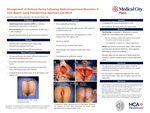
Background & Significance: Abdominoperineal resection (APR) is a complex surgical procedure commonly performed for low rectal or anal cancer. A rare complication following this surgery is the development of perineal hernias, occurring in 1-26% of cases. There is no universally accepted treatment for perineal hernias, and management is often individualized. Treatment options include conservative measures, transabdominal versus transperineal repair, varying patient positioning, and the use of mesh. This case report describes a transperineal repair in a prone jack-knife position using mesh for pelvic floor reconstruction. Case Presentation: A 54-year-old female status post robotic APR for rectal adenocarcinoma presented with symptomatic perineal hernia. Physical examination revealed small bowel loops protruding under the skin, confirming the hernia and enterocele. The patient was placed in a prone jack-knife position and a longitudinal incision was made through the previous APR staple line. The hernia sac was identified with small bowel protrusion. After adhesiolysis, the hernia sac was ligated without damage to the intestine. The pelvic floor fascia was closed and ACell biologic mesh was placed to repair the pelvic floor defect. Perineoplasty provided additional support, followed by closure of the deep subcutaneous tissue and skin. Discussion: The transperineal approach with prone jack-knife positioning was chosen for optimal visualization of the hernia and surrounding structures. A systematic review of perineal hernia repairs suggests that both perineal and abdominal approaches have similar recurrence rates, but the perineal approach was preferred for this patient. Mesh repair has been associated with lower recurrence rates compared to non-mesh repair and offers benefits such as reduced bacterial infection risk and better integration into irradiated tissue. This case emphasizes transperineal approach as a preferred treatment option but also highlights the importance of tailoring the surgical approach to the patient's anatomy and the surgeon's expertise.
Original Publisher
HCA Healthcare Graduate Medical Education
Recommended Citation
Chen, Evan; Macaluso, Anthony; and Pigneri, Danielle, "Management of Perineal Hernia Following Abdominoperineal Resection: A Case Report Using Transperineal Repair and Mesh" (2025). North Texas Research Forum 2025. 103.
https://scholarlycommons.hcahealthcare.com/northtexas2025/103