


North Texas GME Research Forum 2026
Files
Download Full Text (828 KB)
Division
North Texas
Hospital
Medical City Denton
Specialty
Orthopedic Surgery
Document Type
Poster
Publication Date
2026
Keywords
pigmented villonodular synovitis, PVNS, tenosynovial giant cell tumor, TGCT
Disciplines
Medicine and Health Sciences | Musculoskeletal Diseases | Neoplasms | Orthopedics
Abstract
Background Pigmented villonodular synovitis (PVNS) is a rare benign neoplastic process that involves extensive proliferation of the synovium of a joint. Development of PVNS has been potentially linked to traumatic etiologies, however, evidence for this remains limited. This case report aims to present a case of PVNS that developed after a traumatic etiology.
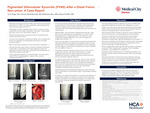
Case Presentation A 62 year old female presented with recurrent left knee effusion and non-union of the left distal femur roughly four years after an MVC and index open reduction and internal fixation with a lateral locking plate and screw construct. Left knee aspiration at initial visit revealed hemorrhagic fluid. Advanced imaging, laboratory workup, and bone biopsy were obtained to rule out potential causes of the non-union. All workup provided no underlying etiology for the non-union or knee hemarthrosis. The patient underwent non-union revision with hardware removal, intramedullary nailing and bone graft placement. Due to concern for the recurrent knee effusion, the knee joint was evaluated which revealed synovitis and hemosiderin deposits. The patient underwent extensive synovectomy, and pathological specimens confirmed results consistent with PVNS. The patient returned for follow-up, and no-longer was developing knee effusions at most recent follow-up (12 weeks from index procdure).
Lessons Learned PVNS can occur after a traumatic injury, and diagnosis remains challenging.
Conclusion PVNS can occur after a traumatic injury, and this case report highlights the first case of PVNS of the knee after a distal femur fracture with subsequent non-union. Surgeons should consider PVNS for recurrent joint effusion after traumatic injuries.
Original Publisher
HCA Healthcare Graduate Medical Education
Recommended Citation
Puga, Troy; Chrabolowski, Jenna; Box, McKenna W.; and Parikh, Kisan, "Pigmented Villonodular Synovitis (PVNS) after a Distal Femur Non-Union: A Case Report" (2026). North Texas GME Research Forum 2026. 17.
https://scholarlycommons.hcahealthcare.com/northtexas2026/17