


North Texas GME Research Forum 2026
Files
Download Full Text (697 KB)
Division
North Texas
Hospital
Medical City Arlington
Specialty
Internal Medicine
Document Type
Poster
Publication Date
2026
Keywords
non-ST-segment elevation myocardial infarction, acute coronary syndrome, inflammatory markers, pan-immune-inflammation value, PIV
Disciplines
Cardiology | Cardiovascular Diseases | Diagnosis | Internal Medicine | Medicine and Health Sciences
Abstract
Background: Cardiovascular diseases (CVD) account for nearly one-third of global mortality, with ischemic heart disease caused by a mismatch between myocardial oxygen supply and demand. Despite advances in percutaneous coronary intervention (PCI) and contemporary pharmacotherapy, patients with non–ST-segment elevation myocardial infarction (NSTEMI) continue to experience substantial residual risk for major adverse cardiovascular events (MACE). As traditional risk stratification tools have limited ability to identify high-risk individuals, interest has shifted toward biomarkers reflecting inflammatory pathways central to atherosclerosis and plaque instability. Hematologic inflammatory markers including pan inflammatory value (PIV), systemic immune inflammation index (SII), neutrophil-lymphocyte ratio (NLR), platelet-lymphocyte ratio (PLR) initially validated in oncology, have emerged as promising predictors of cardiovascular disease.
Methods: We performed a retrospective analysis of the North Texas healthcare database including adults (≥18 years) hospitalized for chest pain (2016–2024) with NSTEMI defined by ESC criteria who underwent successful PCI of culprit vessel. Patients were stratified into MACE and non-MACE cohorts, followed for 7 days from index hospitalization. MACE comprised heart failure (HF), ischemic stroke (IS), in-stent restenosis (ISR), malignant arrhythmia (MA), cardiac arrest (CA), in-hospital mortality (IHM) and cardiogenic shock (CS). ROC curve analysis was used to determine the performance of the PIV, SII, NLR and PLR.
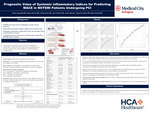
Results: Among 1,945 patients with NSTEMI, 805 experienced MACE. Compared with the non-MACE cohort, patients with MACE were older (median age 69.5 vs 62.0 years), longer hospital length of stay (4 vs 2 days), and a higher prevalence of diabetes and hyperlipidemia. The MACE cohort included a slightly higher proportion of females and Hispanic patients, with lower proportions of males, White, and African American patients. Patients with MACE demonstrated higher neutrophil and platelet counts with lower lymphocyte counts, while monocyte levels were similar between groups. Inflammatory indices were consistently higher in the MACE cohort, including PIV (589.2 vs 429.6), SII (830.9 vs 643.8), PLR (135.8 vs 116.8), and NLR (3.8 vs 2.8). HF accounted for the majority of MACE events (89.01%), followed by MA (11.62%), CS (9.71%), IHS (6.69%), IS (4.78%), CA (4.62%), ISR (0.96%); cardiogenic shock in 42 patients. ROC analysis demonstrated modest discriminative performance for MACE, with AUCs of 0.588 for PIV, 0.584 for SII, 0.597 for NLR, and 0.570 for PLR.
Conclusion: Readily available hematologic inflammatory indices were higher among NSTEMI patients experiencing early MACE following PCI, underscoring the role of systemic inflammation in short-term post-NSTEMI risk and supporting the need for prospective validation.
Original Publisher
HCA Healthcare Graduate Medical Education
Recommended Citation
Lapsiwala, Boney; Sharma, Aditya; Khan, Usman; Parmar, Jorim; Soloman, Justin; Vibhuti, Veeranna; and Khalafi, Mehdi, "Prognostic Value of Systemic Inflammatory Indices for Predicting MACE in NSTEMI Patients Undergoing PCI" (2026). North Texas GME Research Forum 2026. 62.
https://scholarlycommons.hcahealthcare.com/northtexas2026/62
Included in
Cardiology Commons, Cardiovascular Diseases Commons, Diagnosis Commons, Internal Medicine Commons