

North Texas GME Research Forum 2026
Files
Download Full Text (3.9 MB)
Division
North Texas
Hospital
Medical City Dallas
Specialty
Emergency Medicine
Document Type
Presentation
Publication Date
2026
Keywords
pediatric emergency department, viral infections, respiratory viral testing, RVT, quality improvement
Disciplines
Emergency Medicine | Medicine and Health Sciences | Pediatrics | Quality Improvement | Respiratory Tract Diseases | Virus Diseases
Abstract
Background: Respiratory viral testing in pediatric emergency departments (EDs) is frequently performed despite limited impact on clinical management for many low-risk presentations. Unnecessary testing increases cost and operational burden may delay patient throughput and can provide false reassurance to caregivers. Additionally, pediatric emergency department nurses agreed with overburden and impact to throughput based on overuse of viral testing (qualitative nursing survey conducted on September 4, 2024 showed >98% felt testing was unnecessary). We hypothesized that reducing testing through standardized team education and discharge processes would not negatively affect patient experience. This initiative aimed to decrease unnecessary respiratory viral testing during respiratory season by implementing a standardized “Swab & Go” workflow supported by clinician and nursing education and standardized discharge instructions.
Methods: We conducted a pre/post quality improvement evaluation in a pediatric ED. Baseline respiratory viral test orders by provider were collected from September 2023 through February 2024. A staged intervention PDSA bundle was implemented, including clinician group discussion (June 17, 2024), Swab & Go pathway revision (July 1, 2024 to the previously published pathway from February 1, 2024), education on appropriate indicators for testing (July 23, 2024) and standardized discharge instructions for families (August 30, 2024). Post-intervention monthly data were collected from September 2024 through February 2025 and compared with the baseline season. The primary outcome was respiratory viral tests per ED visit (tests/visit). Provider-level performance was measured against a goal of ≥50% reduction from baseline. The “Swab & Go” pathway applied to children older than 12 months who were discharged home with reassuring vital signs and a presumed viral respiratory illness.
Results: During the baseline period (September 2023–February 2024), testing averaged 1.19 tests per visit across 20,810 visits. In the post-intervention period, testing decreased to 0.47 tests per visit across 10,283 visits, representing an absolute reduction of 0.72 tests per visit (72 fewer tests per 100 visits) and a 60.5% relative reduction. Fifteen of sixteen providers reduced respiratory viral testing overall with 10/17 providers decreasing by 60% in this short timeframe since intervention.
Conclusions: Implementation of a standardized “Swab & Go” pathway with staged multidisciplinary education and discharge standardization significantly reduced respiratory viral testing in a pediatric ED. Importantly, patient experience scores improved during the intervention period and remained above the national 75% top-box benchmark.
Original Publisher
HCA Healthcare Graduate Medical Education
Recommended Citation
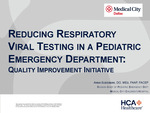
Suessman, Anna, "Reducing Respiratory Viral Testing in a Pediatric Emergency Department: A Quality Improvement Initiative" (2026). North Texas GME Research Forum 2026. 85.
https://scholarlycommons.hcahealthcare.com/northtexas2026/85
Included in
Emergency Medicine Commons, Pediatrics Commons, Quality Improvement Commons, Respiratory Tract Diseases Commons, Virus Diseases Commons