


North Texas GME Research Forum 2026
Files
Download Full Text (1.2 MB)
Division
North Texas
Hospital
Medical City Arlington
Specialty
Obstetrics & Gynecology
Document Type
Poster
Publication Date
2026
Keywords
subcutaneous emphysema, laparoscopic surgery, robotic surgery, hysterectomy, surgical complications, uterine fibroids
Disciplines
Medicine and Health Sciences | Obstetrics and Gynecology | Surgical Procedures, Operative
Abstract
Background Subcutaneous emphysema is the presence of air within subcutaneous tissues, often presenting as swelling and palpable crepitus. Air may spread along fascial planes and arise from traumatic, iatrogenic, infectious, or spontaneous sources. In laparoscopic surgery, it is most commonly related to carbon dioxide insufflation. Reported incidence following laparoscopic procedures ranges from 2% to 24%, depending on procedure type, surgical duration, insufflation pressure, and patient factors. In gynecologic laparoscopy, incidence has been reported as low as 2.3% in some studies, with rates up to 10–15% in others, particularly with higher intraabdominal pressures. Although often benign, extensive subcutaneous emphysema may lead to significant complications, including airway compromise.
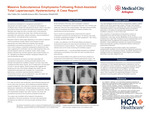
Case Report A 51-year-old woman with symptomatic uterine fibroids presented with chronic pelvic pain and heavy uterine bleeding and elected definitive surgical management. She underwent a planned robot-assisted total laparoscopic hysterectomy with bilateral salpingo-oophorectomy, lysis of adhesions, and cystoscopy. The patient was prepped and draped in the usual sterile fashion. During induction of anesthesia, difficulty with endotracheal intubation was noted; however, the airway was successfully secured, and the procedure proceeded as planned. The surgery was completed without apparent intraoperative complications. During the procedure, one trocar was inadvertently dislodged by the robotic arm and promptly reinserted. At the conclusion of the case, prior to extubation, extensive subcutaneous emphysema involving the abdomen, chest wall, neck, and face was noted upon removal of the surgical drapes. Vital signs remained stable, though the anesthesia team reported increasing ventilatory flow requirements during the procedure. Given concern for potential airway compromise from external compression, the decision was made to maintain endotracheal intubation. The patient was transferred to the intensive care unit for close monitoring and further management.
Lessons Learned This case highlights that while robot-assisted hysterectomy is generally safe, extensive subcutaneous emphysema remains a rare but clinically significant complication. Early recognition is critical, as extension to the neck and face increases the risk of airway compromise. Trocar dislodgement may contribute to extraperitoneal insufflation and should prompt reassessment of port integrity and insufflation parameters. Close collaboration between surgical and anesthesia teams is essential to guide airway management and postoperative disposition.
Conclusions Extensive subcutaneous emphysema following robot-assisted laparoscopic hysterectomy is uncommon but may have significant airway implications. Vigilance for atypical postoperative findings, careful management of trocar integrity, and prompt escalation of care are essential to ensuring patient safety and favorable outcomes.
Original Publisher
HCA Healthcare Graduate Medical Education
Recommended Citation
Valdez, Alia; Sciacca, Isabella; and Oladell, Charmaine, "Massive Subcutaneous Emphysema Following Robot-Assisted Total Laparoscopic Hysterectomy: A Case Report" (2026). North Texas GME Research Forum 2026. 16.
https://scholarlycommons.hcahealthcare.com/northtexas2026/16