

North Texas GME Research Forum 2026
Files
Download Full Text (1.1 MB)
Division
North Texas
Hospital
Medical City Fort Worth
Specialty
Internal Medicine
Document Type
Poster
Publication Date
2026
Keywords
bronchial artery aneurysm, BAA, vascular abnormality, hemoptysis
Disciplines
Internal Medicine | Medicine and Health Sciences | Respiratory Tract Diseases
Abstract
Background: Bronchial artery aneurysm (BAA) is a rare vascular abnormality and an uncommon cause of hemoptysis. Although many BAAs are asymptomatic, rupture can result in life-threatening hemorrhage and shock. Proximal BAAs arising near the bronchial artery origin are particularly rare and may be underrecognized due to nonspecific clinical and radiographic findings.
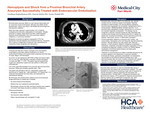
Case Presentation: Patient is a 49-year-old male with a history of pituitary tumor resection complicated by secondary adrenal insufficiency and hypothyroidism presented with three days of cough, fatigue, and hemoptysis. He was hypotensive and hypoxic on arrival and required vasopressor support with stress-dose corticosteroids. Computed tomography angiography (CTA) of the chest showed diffuse ground-glass opacities, hypertrophied right bronchial arteries, and a 14-mm proximal right bronchial artery aneurysm near its origin. Interventional radiology was consulted and patient stabilized after transcatheter bronchial artery coil embolization.
Lessons Learned: BAAs are infrequently encountered and often misdiagnosed due to overlapping presentations with pulmonary infection, malignancy, or pulmonary embolism. Importantly, the risk of rupture is independent of aneurysm size, underscoring the need for prompt recognition and intervention once identified. Multiphasic CTA is critical for diagnosis, as it allows precise localization, characterization of arterial anatomy, and procedural planning. Endovascular embolization represents a safe and effective treatment modality, even in patients presenting with hemodynamic compromise.
Conclusion: This case highlights proximal bronchial artery aneurysm as a rare but critical cause of hemoptysis and hemodynamic instability. In patients with hemoptysis and unexplained shock, particularly when imaging suggests hilar pathology, vascular etiologies should be considered. Early CTA and endovascular management can be lifesaving.
Original Publisher
HCA Healthcare Graduate Medical Education
Recommended Citation
Raghuthaman, Gautham; Mehta, Charmi; and Hudali, Tamer, "Hemoptysis and Shock from a Proximal Bronchial Artery Aneurysm Successfully Treated with Endovascular Embolization" (2026). North Texas GME Research Forum 2026. 25.
https://scholarlycommons.hcahealthcare.com/northtexas2026/25