

North Texas GME Research Forum 2026
Files
Download Full Text (358 KB)
Division
North Texas
Hospital
Medical City Fort Worth
Specialty
Family Medicine
Document Type
Poster
Publication Date
2026
Keywords
quality improvement, graduate medical education, medical students, clerkship
Disciplines
Family Medicine | Medical Education | Medicine and Health Sciences
Abstract
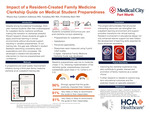
BACKGROUND: Third-year medical students enter the family medicine clerkship with strong foundations in the basic medical sciences. However, they can feel underprepared to meet the demands of outpatient care, including navigating clinic workflows, documenting efficiently, and leading patient-centered visits. This transition-to-clerkship learning curve may contribute to stress during a critical phase of clinical development. Structured educational support during this transition has the potential to enhance learner confidence, promote meaningful learning, and foster positive engagement with family medicine. Through resident-led quality improvement, this project aimed to improve medical student preparedness and confidence for the family medicine clerkship using a resident-created intervention.
METHODS: A prospective pre-post quality improvement initiative was conducted during a third-year medical student family medicine clerkship at an outpatient site. Guided by a learner needs assessment, residents developed a Family Medicine Clerkship Guide addressing clinic workflow, pre-charting strategies, patient presentation frameworks, documentation guidance, rotation expectations, and shelf exam preparation. Students completed anonymous pre- and post-clerkship surveys assessing preparedness (5-point Likert scale), anticipated challenges, satisfaction, and perceived applicability. Preparedness outcomes were compared descriptively, and effect size (Cohen’s d) was calculated to assess educational impact. This project was deemed quality improvement and exempt from institutional review board review.
RESULTS: Pre-clerkship surveys were completed by 31 students, and post-clerkship surveys by 21. Baseline preparedness was low to moderate (mean 3.13), with 42% of students reporting being mostly or fully prepared. Following implementation of the clerkship guide, preparedness improved substantially (post mean 4.10; Cohen’s d ≈ 0.9), with 81% reporting being mostly or fully prepared and no students reporting being slightly or not prepared. Students identified pre-charting workflows, patient presentation frameworks, documentation guidance, and shelf exam preparation as the most helpful components. Learner satisfaction was high: 91% agreed or strongly agreed the guide provided tools applicable to outpatient clerkship activities, 96% felt it would positively impact their rotation, and 91% were likely or very likely to recommend it to peers. Few clarity concerns were identified, with one suggestion to incorporate visual aids for electronic health record templates.
CONCLUSION: A resident-created family medicine clerkship guide meaningfully improved medical student preparedness and confidence for outpatient clerkship care, addressing a common transition gap in undergraduate medical education. This scalable, low-cost intervention demonstrates the value of resident-led quality improvement in enhancing ambulatory learning environments while simultaneously supporting resident-as-teacher development. Similar onboarding tools may be adaptable across outpatient clerkships to improve learner readiness and experience.
Original Publisher
HCA Healthcare Graduate Medical Education
Recommended Citation
Lambert-Johnson, Shana-Kay; Mir, Tasaduq; and Barr, Fredricka, "Impact of a Resident-Created Family Medicine Clerkship Guide on Medical Student Preparedness" (2026). North Texas GME Research Forum 2026. 3.
https://scholarlycommons.hcahealthcare.com/northtexas2026/3