


North Texas GME Research Forum 2026
Files
Download Full Text (2.5 MB)
Division
North Texas
Hospital
Medical City Arlington
Specialty
Internal Medicine
Document Type
Poster
Publication Date
2026
Keywords
thrombotic thrombocytopenic purpura, TTP, blood coagulation disorders
Disciplines
Hemic and Lymphatic Diseases | Internal Medicine | Medicine and Health Sciences | Pathological Conditions, Signs and Symptoms
Abstract
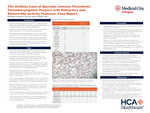
Introduction/Background: Thrombotic Thrombocytopenic Purpura (TTP) is a multisystem disease that can lead to multiorgan failure by disseminated mechanical destruction, microangiopathic hemolytic anemia, and thrombocytopenia. Most TTP cases are classified as acquired or hereditary; however, sporadic immune TTP with a refractory episode during the same hospital admission is not well documented in the literature. Furthermore, seizure-like activity during plasma exchange is not a common adverse effect.
Case Presentation: A 35-year-old African American female with no documented medical, surgical, or social history, changes to medications, or lifestyle changes presented with full body fatigue, fever, loss of balance, and confusion. On arrival, labs demonstrated severe thrombocytopenia and anemia with elevation in bilirubin specifically indirect bilirubin, ferritin, lactate dehydrogenase, troponins, and creatinine. TTP was the suspected diagnosis after a peripheral blood smear showed extensive schistocytes. Plasma exchange with Methylprednisolone IV was immediately initiated. During the night on day 2, one seizure-like episode with transient right facial and right sided weakness followed by confusion witnessed. Plasma exchange stopped. On day 6, ADAMTS13 was < 2%. By day 13, labs then showed worsening thrombocytopenia and anemia, plasma exchange restarted. Stable improvement in labs and symptoms on day 19 and the patient was cleared for discharge from the hospital.
Learning points: Most TTP cases are diagnosed as acquired with a definite etiology. However, sporadic immune TTP is considered a diagnosis of exclusion. Regardless, it is extremely important to identify and begin emergent treatment and preferably guided by a hematologist where available. In rare cases of refractory TTP, it is crucial that the patient understands the importance of being followed by outpatient hematology to avoid or manage relapses. Overall, our case report may provide new insights on monitoring the mainstay treatment regimen for adverse effects or refractory symptoms.
Original Publisher
HCA Healthcare Graduate Medical Education
Recommended Citation
Gremmer, Brandon and Folefack, Alain, "The Unlikely Case of Sporadic Immune Thrombotic Thrombocytopenic Purpura with Refractory and Seizure-like Activity Features: Case Report" (2026). North Texas GME Research Forum 2026. 30.
https://scholarlycommons.hcahealthcare.com/northtexas2026/30
Included in
Hemic and Lymphatic Diseases Commons, Internal Medicine Commons, Pathological Conditions, Signs and Symptoms Commons