


North Texas GME Research Forum 2026
Files
Download Full Text (291 KB)
Division
North Texas
Hospital
Medical City Fort Worth
Specialty
Family Medicine
Document Type
Poster
Publication Date
2026
Keywords
st-elevation myocardial infarction, STEMI, young adult
Disciplines
Cardiovascular Diseases | Family Medicine | Medicine and Health Sciences
Abstract
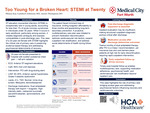
Background: ST-elevation myocardial infarction (STEMI) is exceptionally rare in young adults, accounting for less than 1% of acute coronary syndromes in individuals younger than 35 years. When it occurs in early adulthood, particularly among women, it introduces diagnostic uncertainty and exposes gaps in post-discharge continuity of care. This case of a 20-year-old female with STEMI highlights the role of primary care in preserving evidence-based therapy while addressing psychosocial determinants of recovery.
Case Presentation: A 20-year-old female presented to her primary care clinic for post-discharge follow-up after hospitalization for an anterior STEMI that began with sudden-onset substernal chest pain radiating to the left arm. Electrocardiography demonstrated anterior ST-segment elevations, and emergent cardiac catheterization revealed an isolated 85% stenosis of the mid left anterior descending artery, treated with percutaneous coronary intervention (PCI) and drug-eluting stent placement. No additional coronary disease or spontaneous coronary artery dissection was identified. Post-infarction echocardiography showed a left ventricular ejection fraction of 40–45% with anterior-apical hypokinesis and grade II diastolic dysfunction. Inpatient evaluation, including lipid panel, hemoglobin A1c, and thyroid-stimulating hormone, was unremarkable. Urine drug screening was positive for marijuana and benzodiazepines but negative for cocaine and methamphetamine. She was discharged on guideline-directed medical therapy, including aspirin, ticagrelor, high-intensity statin therapy, metoprolol succinate, sacubitril/valsartan, spironolactone, and losartan, with a recommendation for 12 months of dual antiplatelet therapy (DAPT). At outpatient follow-up, she was clinically stable but reported impending loss of insurance coverage, limiting ticagrelor affordability to three months. Her body mass index was 42 kg/m², and she had a history of severe depression and anxiety with visible affective distress, declining depression screening. Motivational interviewing was initiated with behavioral health support. Outpatient management expanded to include advanced lipid testing, thrombophilia and autoimmune evaluation, cardiology follow-up, weight management, substance use counseling, medication assistance enrollment, and transition to clopidogrel to maintain DAPT adherence.
Learning Points: STEMI in patients younger than 35 years is uncommon and warrants evaluation beyond traditional atherosclerotic risk factors. Standard inpatient testing may be insufficient, making structured outpatient diagnostic expansion essential. Twelve months of DAPT following acute coronary syndrome with PCI is a Class I guideline recommendation, and failure to address medication affordability and insurance instability increases the risk of premature discontinuation. Cardiac rehabilitation and psychological support are essential components of recovery. This case demonstrates how coordinated outpatient primary care can preserve evidence-based therapy while addressing the clinical and psychosocial consequences of premature myocardial infarction.
Original Publisher
HCA Healthcare Graduate Medical Education
Recommended Citation
Lambert-Johnson, Shana-Kay and Thompson, Jason, "Too Young for a Broken Heart: STEMI at Twenty" (2026). North Texas GME Research Forum 2026. 36.
https://scholarlycommons.hcahealthcare.com/northtexas2026/36