


North Texas GME Research Forum 2026
Files
Download Full Text (311 KB)
Division
North Texas
Hospital
Not Listed
Specialty
Emergency Medicine
Document Type
Poster
Publication Date
2026
Keywords
nitrous oxide, ketamine, analgesia, sedation, length of stay, pediatric emergency department
Disciplines
Anesthesia and Analgesia | Emergency Medicine | Medicine and Health Sciences | Pediatrics
Abstract
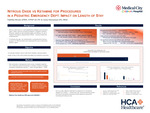
Background Nitrous oxide (N₂O) is a well-established analgesic and anxiolytic agent, widely used for procedural sedation in pediatric dentistry. Despite its demonstrated safety and efficacy, its use in Pediatric Emergency Departments (PEDs) remains limited and underexplored. To address this gap, we implemented a comprehensive training program for PED providers and introduced N₂O as an alternative sedation agent.
Objective We hypothesized that using N₂O for procedural sedation would significantly reduce patient length of stay (LOS) without compromising safety or outcomes.
Methods We conducted a retrospective chart review of pediatric patients who underwent painful procedures in a tertiary children’s hospital emergency department. The study was reviewed and approved by the hospital’s Institutional Review Board (IRB). The primary outcome was LOS in patients receiving ketamine versus N₂O. Secondary outcomes included procedure type and complications. Data for ketamine were collected from January 1, 2023, to December 31, 2024, and for N₂O from March 1, 2025 (its inception) to August 31, 2025. De-identified data were analyzed to compare LOS between the two sedation modalities using inferential statistics (independent samples t-test); side effects were descriptively summarized.
Results Out of 288 patients who received ketamine sedation, 260 met inclusion criteria, with a mean LOS of 459.40 minutes (Sd, 166). In comparison, 47 patients who received nitrous oxide (N₂O), 43 of whom met inclusion criteria, with a mean LOS of 190.95 (sd, 81.43) minutes. With a mean difference of 268 minutes (Welch’s t (111.1)=16.6, p < .001) and a large effect size (Cohen’s d = 1.71), this finding reflects a clinically and operationally meaningful reduction in LOS with N₂O. The most common procedures under ketamine were fracture reductions, followed by laceration repairs and abscess drainages. Under N₂O, laceration repairs were most frequent, followed by fracture reductions and abscess drainages. Hypoxia and nausea/vomiting occurred in 34% of ketamine cases, with hives reported in one patient. 3 In contrast, nausea, vomiting, or excitability occurred in 18% of N₂O cases.
Conclusion Nitrous oxide is a safe and effective procedural sedation option that significantly reduced LOS and is associated with fewer adverse events compared to ketamine. Implementing nitrous oxide as an alternative to ketamine enhances pediatric procedural care by significantly shortening LOS by over 4 hours, potentially reducing emergency department crowding and resource utilization while improving the patient experience.
Original Publisher
HCA Healthcare Graduate Medical Education
Recommended Citation
Brock, Tabitha and Suessman, Anna, "Nitrous Oxide vs. Ketamine: Impacts on Pediatric Emergency Department Length of Stay" (2026). North Texas GME Research Forum 2026. 44.
https://scholarlycommons.hcahealthcare.com/northtexas2026/44