

North Texas GME Research Forum 2026
Files
Download Full Text (614 KB)
Division
North Texas
Hospital
Medical City Denton
Specialty
Orthopedic Surgery
Document Type
Poster
Publication Date
2026
Keywords
GLP-1 receptor agonist, rotator cuff repair, diabetes, postoperative outcomes
Disciplines
Endocrine System Diseases | Medicine and Health Sciences | Orthopedics | Surgical Procedures, Operative
Abstract
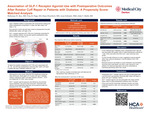
Background Diabetes impairs tendon healing after rotator cuff repair (RCR), with early postoperative poor glycemic control linked to a higher failure risk in studies. GLP-1 receptor agonists (GLP-1RAs) are increasingly used for glycemic control. Preclinical studies indicate that GLP-1RA may benefit rotator cuff healing through anti-inflammatory mechanisms as well. However, real-world data on the effects of GLP-1RAs on RCR outcomes remain incompletely understood.
Methods We conducted a retrospective cohort study using an institutional dataset (01/01/2016 to 09/30/2024) of adults aged 18-74 years with type 2 diabetes who underwent RCR. GLP-1RA exposure was established by home medication lists. Patients with autoimmune diseases, type 1 diabetes, chronic kidney disease, myocardial infarction, associated shoulder-girdle fractures, or shoulder arthroplasty were excluded. Outcome measures were assessed up to 1 year after surgery and included ED visits, pneumonia, revision shoulder surgery for rotator cuff re-tear or conversion to arthroplasty, and postoperative stiffness. Propensity scores were estimated using logistic regression, and patients were matched 1:1 to patients with diabetes not on a GLP-1RA. Post-match balance was assessed using standardized mean differences. Post-matching outcomes were evaluated using bias-reduced logistic regression for rare events, with cluster-robust standard errors within matched pairs. The Benjamini-Hochberg false discovery rate adjustment was applied to all modeled outcomes.
Results Among 10,354 eligible patients, 1,689 (16.3%) were users of GLP-1RA. After application of exclusion criteria, 1,555 GLP-1RA users were matched with 1,555 non-users (N = 3,110). After multiplicity adjustment, GLP-1RA use was associated with higher odds of postoperative stiffness (OR 1.953, 95% CI 1.232-3.096; adjusted P = .048). No significant associations were observed for ED readmissions (30/90/365 days), pneumonia readmissions (90/365 days), revision RCR or conversion to arthroplasty (all adjusted P > .30). Other outcomes were not analyzable due to low event counts.
Conclusions In this propensity score-matched cohort of diabetic patients undergoing RCR, GLP-1RA use was not associated with differences in most short-term perioperative outcomes. A statistically significant association with postoperative stiffness within 1 year was observed. Overall, postoperative events were uncommon, and the finding should be interpreted as associative and hypothesis-generating for future studies.
Original Publisher
HCA Healthcare Graduate Medical Education
Recommended Citation
Box, McKenna W.; Puga, Troy B.; Drawbert, Hans; Erdemir, Aysu; and Riehl, John T., "Association of GLP-1 Receptor Agonist Use with Postoperative Outcomes After Rotator Cuff Repair in Patients with Diabetes: A Propensity Score–Matched Analysis" (2026). North Texas GME Research Forum 2026. 47.
https://scholarlycommons.hcahealthcare.com/northtexas2026/47
Included in
Endocrine System Diseases Commons, Orthopedics Commons, Surgical Procedures, Operative Commons