


North Texas GME Research Forum 2026
Files
Download Full Text (610 KB)
Division
North Texas
Hospital
Medical City Plano
Specialty
Transitional Year
Document Type
Poster
Publication Date
2026
Keywords
cholecystectomy, choledochoscopy, cholelithiasis, preoperative endoscopic retrograde cholangiopancreatography, ERCP, laparoscopic surgery, robotic surgery
Disciplines
Digestive System Diseases | Medicine and Health Sciences | Surgery
Abstract
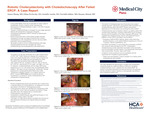
Background: In the United States, there are an estimated 20 million cases of cholelithiasis, though a majority remain asymptomatic. Development of choledocholithiasis is seen in 10%-20% of those with cholelithiasis. Typically, choledocholithiasis is managed via a two-stage approach starting with endoscopic retrograde cholangiopancreatography (ERCP) followed by laparoscopic cholecystectomy on the same admission. More recent trends have seen a shift towards surgeon-directed management of the common bile duct through one-stage procedures that combine cholecystectomy with intraoperative common bile duct (CBD) exploration using choledochoscopy. We present a case of chronic choledocholithiasis with large, impacted gallstones that was managed with robotic cholecystectomy, choledochotomy, and choledochoscopy after failed ERCP.
Case Presentation: An 86-year-old female presented with a 2-month history of abdominal pain with associated weight loss and decreased oral intake. The patient was initially seen at an outside hospital where CT imaging revealed cholecystitis and choledocholithiasis with two large 2-cm CBD stones. ERCP was attempted but duct cannulation was unsuccessful due to a duodenal stricture. The patient was transferred to our facility where the patient was taken to the operating room and a robotic choledochotomy was created with subsequent choledochoscopy. Two large impacted CBD stones were identified and successfully cleared from the duct with a combination of electrohydraulic lithotripsy, wire snare, irrigation, and manual manipulation. A robotic cholecystectomy was then performed. The patient was discharged from the hospital on postoperative day 3 without the need for any further intervention.
Discussion and Conclusion: Choledocholithiasis management currently has an evolving treatment landscape. The introduction of intraoperative choledochoscopy offers a modern, minimally invasive, single-stage method for CBD exploration and stone elimination, thereby reducing the dependence on gastroenterology (GI) intervention and avoiding added risks associated with ERCP. Furthermore, common bile duct exploration is the current bail out procedure after failed ERCP further supporting the expansion of minimally invasive choledochoscopy. This case suggests minimally invasive intraoperative choledochoscopy is a safe and effective treatment for managing complex choledocholithiasis, even in patients who have failed ERCP.
Original Publisher
HCA Healthcare Graduate Medical Education
Recommended Citation
Zhang, James; Pavlovsky, Ethan; Austin, Jennifer; Jabbar, Furrukh; and Ahmed, Hassan, "Robotic Cholecystectomy with Choledochoscopy After Failed ERCP: A Case Report" (2026). North Texas GME Research Forum 2026. 48.
https://scholarlycommons.hcahealthcare.com/northtexas2026/48