

North Texas GME Research Forum 2026
Files
Download Full Text (1004 KB)
Division
North Texas
Hospital
Medical City Arlington
Specialty
Internal Medicine
Document Type
Poster
Publication Date
2026
Keywords
calcinosis cutis, end-stage renal disease, ESRD, kidney disease, chronic kidney disease mineral bone disorder, CKD-MBD
Disciplines
Internal Medicine | Medicine and Health Sciences | Nutritional and Metabolic Diseases | Skin and Connective Tissue Diseases
Abstract
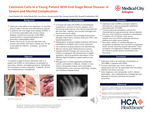
BACKGROUND/ INTRODUCTION: Calcinosis cutis is a rare but serious complication of end-stage renal disease (ESRD), often related to disordered calcium–phosphate metabolism. It can lead to significant morbidity, recurrent infections, and challenging management decisions.
CASE PRESENTATION: We present a 23-year-old male with ESRD on hemodialysis, hypertension, anemia of chronic disease, and a left upper extremity arteriovenous fistula who developed progressive pain, swelling, and purulent drainage involving the left third and fourth digits. Imaging revealed extensive soft tissue calcifications consistent with calcinosis cutis. His hospital course was complicated by recurrent infections, osteomyelitis, and gangrene despite antibiotic therapy and wound care, ultimately requiring multiple surgical debridements and amputations.
The patient underwent serial washouts, debridement, and digit amputations in the setting of ongoing infection. Management emphasized multidisciplinary collaboration, optimization of dialysis, aggressive phosphate control, non-calcium phosphate binders, and infectious disease management. Despite these measures, disease progression highlighted the aggressive nature of calcinosis cutis in ESRD.
DISCUSSION: Calcinosis cutis in ESRD is a complication of CKD–mineral bone disorder, driven by hyperphosphatemia and secondary/tertiary hyperparathyroidism. This case is unique due to severe, recurrent tumoral calcinosis in a 23-year-old, causing vascular compromise and pain despite hemodialysis. Current focus emphasizes early recognition and prevention through phosphate control, dialysis optimization, and management of refractory hyperparathyroidism.
TEACHING / LEARNING POINTS:
- Calcinosis cutis in ESRD is a manifestation of CKD–mineral bone disorder, driven primarily by hyperphosphatemia, elevated calcium–phosphate product, and secondary or tertiary hyperparathyroidism.
- Tumoral calcinosis can mimic infection or calciphylaxis, presenting with pain, swelling, erythema, and skin breakdown; secondary infection is common and must be actively excluded.
- AV fistula–related venous hypertension can exacerbate limb swelling and delay healing, confounding clinical assessment of infection and ischemia.
- Management requires a multidisciplinary approach, including nephrology, surgery, and infectious disease, with emphasis on preventing recurrence rather than repeated surgical intervention.
Original Publisher
HCA Healthcare Graduate Medical Education
Recommended Citation
Mulaka, Gopi; Shaik, Babu; Manimekalai, Jaya Surya; Dandu, Durga; and Prabhukhot, Rupali, "Calcinosis Cutis in a Young Patient With End-Stage Renal Disease: A Severe and Morbid Complication" (2026). North Texas GME Research Forum 2026. 5.
https://scholarlycommons.hcahealthcare.com/northtexas2026/5
Included in
Internal Medicine Commons, Nutritional and Metabolic Diseases Commons, Skin and Connective Tissue Diseases Commons