

North Texas GME Research Forum 2026
Files
Download Full Text (194 KB)
Division
North Texas
Hospital
Medical City Fort Worth
Specialty
Internal Medicine
Document Type
Poster
Publication Date
2026
Keywords
Titin mutations, TTN, dilated cardiomyopathy, DCM, genetic testing, COVID-19, corona virus, SARS-CoV-2
Disciplines
Cardiovascular Diseases | Congenital, Hereditary, and Neonatal Diseases and Abnormalities | Internal Medicine | Medicine and Health Sciences | Virus Diseases
Abstract
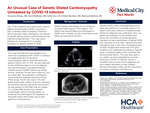
Introduction: Titin (TTN) mutations are a well-known cause of dilated cardiomyopathy (DCM), occurring in approximately 25% of familial cases of idiopathic DCM and 18% of sporadic cases. Recognition and referral for genetic testing remains underutilized but has important prognostication and helps the patient better understand the disease transmission. This case report stresses the importance of a complete evaluation for genetic causes of DCM.
Case Presentation: A 21-year-old male who was adopted as an infant was hospitalized with COVID-19 infection and diagnosed with non-ischemic cardiomyopathy with an initial left ventricular ejection fraction (EF) of 10%. He was assumed to have DCM secondary to his viral infection and was discharged on guideline-directed medical therapy (GDMT) without any further workup. However, he was lost to follow-up, and two years later, he presented in cardiogenic shock leading to pulseless electrical activity (PEA) arrest. His EF then was 5-10% with global hypokinesis, dilation of all four chambers, and severely reduced right ventricular (RV) function. He was placed on venoarterial extracorporeal membrane oxygenation (VA ECMO) with an Impella 5.5. Cardiac magnetic resonance imaging (MRI) showed four-chamber cardiomegaly without contrast uptake, no evidence of arrhythmogenic RV dysplasia, no focal wall motion abnormality, and no late gadolinium enhancement. Genetic testing was positive for an autosomal dominant heterozygous TTN mutation. The patient was decannulated and discharged on GDMT and a LifeVest. His EF at the three-month follow-up improved to 50-55%.
Discussion: Genetic DCM is often underdiagnosed due to false assumptions or incomplete workup. Our patient went years without a complete workup before his diagnosis was understood. Also, our patient was adopted, but the studies have shown the importance of screening family members for early identification of familial DCM and improved survival rates. Gene-environment interactions play a vital role in the development of DCM. Studies have shown that TTN gene mutations can predispose individuals to specific types of cardiomyopathy when combined with environmental factors. This was likely seen in our patient, as both presentations occurred following a COVID-19 infection. Hence, a complete workup at the time of diagnosis will aid in patient education on their disease, familial transmission rates, and the importance of medical compliance and follow-up.
Original Publisher
HCA Healthcare Graduate Medical Education
Recommended Citation
Molugu, Greeshma; McMahan, Daniel; Haci, Seline; Mundluru, Giridhar; and Madhrira, Machaiah, "An Unusual Case of Genetic Dilated Cardiomyopathy Unmasked by COVID-19 Infection" (2026). North Texas GME Research Forum 2026. 57.
https://scholarlycommons.hcahealthcare.com/northtexas2026/57
Included in
Cardiovascular Diseases Commons, Congenital, Hereditary, and Neonatal Diseases and Abnormalities Commons, Internal Medicine Commons, Virus Diseases Commons