


North Texas GME Research Forum 2026
Files
Download Full Text (1.2 MB)
Division
North Texas
Hospital
Medical City Fort Worth
Specialty
Internal Medicine
Document Type
Poster
Publication Date
2026
Keywords
strongyloidiasis, SLE, systemic lupus erythematosus, SLE, roundworm infection, parasitic infection
Disciplines
Immune System Diseases | Infectious Disease | Internal Medicine | Medicine and Health Sciences | Parasitic Diseases
Abstract
Introduction: Disseminated strongyloidiasis is a very rare condition with case-fatality rates approaching 90%. However, the diagnosis is often delayed because of nonspecific presenting symptoms. Early diagnosis relies on a high index of clinical suspicion, especially in immunocompromised hosts. Long-term corticosteroid therapy, leading to some suppression of inflammatory and immunologic responses, is a well-known risk factor for severe strongyloidiasis.
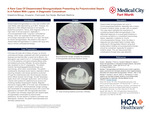
Case presentation: A 52-year-old male with a past medical history of lupus on chronic corticosteroid therapy presented with chief complaints of dyspnea and diarrhea. He has a recent history of travel to Mexico. Hemoglobin was 5.3. CTAP with contrast showed diffuse colitis and bilateral pulmonary infiltrates. CTA showed no evidence of active bleed. Had recent upper and lower GI scopes which were negative. Patient developed acute hypoxic respiratory failure requiring intubation with bloody secretions suctioned through the ET tube. Had bronchoscopy which showed active alveolar hemorrhage. He later developed septic shock with multiorgan dysfunction. Blood cultures were positive for staphylococcus aureus and multidrug resistant enterobacter cloace. His MRI Brain was remarkable for pyogenic ventriculitis. BAL cytology was remarkable for elongated structures with worm like appearance consistent with Strongylides stercoralis. The patient was finally diagnosed to have disseminated strongyloides complicated by polymicrobial bacteremia. He was started on iv ivermectin and albendazole, however, the patient decompensated and passed away.
Discussion: Severe strongyloidiasis is a risk in every corticosteroid-treated patient who has traveled to a soil-infested country, as seen with our patient. This case highlights the importance of considering disseminated strongyloidiasis in the differential diagnosis of unusual gastrointestinal or pulmonary symptoms or unexplained polymicrobial sepsis, especially in patients on chronic immunosuppressive therapy. Hence, screening for Strongyloides infection using stool studies before initiating immunosuppressive therapy should be considered, especially in endemic areas. This can help prevent fatal complications through early case detection.
Original Publisher
HCA Healthcare Graduate Medical Education
Recommended Citation
Molugu, Greeshma; Chennupati, Anupama; Dereje, Ayo; and Madhrira, Machaiah, "A Rare Case of Disseminated Strongyloidiasis Causing Polymicrobial Sepsis in a Patient with Lupus: A Diagnostic Conundrum" (2026). North Texas GME Research Forum 2026. 74.
https://scholarlycommons.hcahealthcare.com/northtexas2026/74
Included in
Immune System Diseases Commons, Infectious Disease Commons, Internal Medicine Commons, Parasitic Diseases Commons