

North Texas GME Research Forum 2026
Files
Download Full Text (226 KB)
Division
North Texas
Hospital
Medical City Arlington
Specialty
Emergency Medicine
Document Type
Poster
Publication Date
2026
Keywords
emergency department, graduate medical education, internships and residency, patient safety
Disciplines
Diagnosis | Emergency Medicine | Medicine and Health Sciences
Abstract
Background
The Emergency Department (ED) is an often chaotic environment where you have little information, little time, and must evaluate for multiple serious conditions. This can be overwhelming for trainees and young physicians. Having a thought process specifically tailored to the ED could be helpful organizing priorities and diagnostic pathways. There are several disease specific core measures that are time sensitive in the ED. Specifically; STEMI, stroke, sepsis, and trauma. Each of these conditions must be rapidly identified, and appropriate pathways initiated.
Trainees are traditionally taught to approach a patient with a wide differential diagnosis for each chief complaint and then formulate a diagnostic and treatment plan. In the emergency department, we first and foremost need to rule out life threatening diagnoses before broadening our differential.
Method
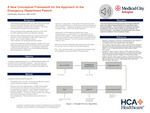
I propose and teach the following stepwise approach.
-Is the patient sick or not sick? Go through the ABCs and if there is a critical intervention needed, act immediately.
-Does one of the core measures apply? STEMI, Stroke, Sepsis, and Trauma are core measures for a good reason and have corresponding time measures. These disease processes need to be rapidly evaluated, treated in a timely manner, and often have subtle presentations. It is helpful to initially consider if one of these is the cause of the patient’s symptoms rather than retrospectively. These conditions can co-exist with one another.
-Coming in or going home? Is this patient well enough to go home, or will they ultimately need to be admitted due to their condition? Developing this gestalt is important to help plan the patient’s stay in the ED and ultimate disposition.
-What are the ~5 life threatening conditions that must be considered (even if you don’t test for it) in every patient with the chief complaint? I often find that differential diagnoses in those new to the ED are often unfocused. If you don’t consider something, you will certainly miss it.
-What is the most likely, actual diagnosis? After considering the life threats, you can then move on to what is the most likely diagnosis.
Conclusion
I have been teaching this thought process to Emergency Medicine interns and rotating medical students for the past several years with good feedback. It has the potential to accelerate acclamation to practicing in the ED, improve metrics on core measures, and improve throughput. The adoption and effectiveness of this method could be the subject of future educational studies.
Original Publisher
HCA Healthcare Graduate Medical Education
Recommended Citation
Houston, Christopher, "A New Conceptual Framework for the Approach to the Emergency Department Patient" (2026). North Texas GME Research Forum 2026. 13.
https://scholarlycommons.hcahealthcare.com/northtexas2026/13