


North Texas GME Research Forum 2026
Files
Download Full Text (378 KB)
Division
North Texas
Hospital
Medical City Fort Worth
Specialty
Internal Medicine
Document Type
Poster
Publication Date
2026
Keywords
aortoenteric fistula, AEF
Disciplines
Digestive System Diseases | Gastroenterology | Internal Medicine | Medicine and Health Sciences
Abstract
BACKGROUND: Primary Aortoenteric Fistulas (PAEFs) are a rare condition that occurs when the native aorta develops an abnormal connection with the gastrointestinal lumen. PAEFs tend to develop within the duodenum, specifically the distal region of the third part of the duodenum, which is retroperitoneal and is anterior to the aorta. Duodenal PAEFs can be difficult to diagnose and are often lethal, given their non-specific presenting symptoms and rapid progression to hemorrhagic shock.
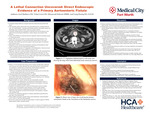
CASE PRESENTATION: This case focuses on a 70-year-old male with a history of T4N2 colon adenocarcinoma with hemicolectomy, active smoking, and abdominal aortic aneurysm (AAA) who was transferred for evaluation of hematemesis. CT of abdomen/pelvis at the outside hospital showed duodenitis with an inflamed segment of the duodenum in direct contact with the infra-renal abdominal aortic aneurysm measuring 4.6cm, concerning for possible duodenal aortoenteric fistula. Repeat CT imaging on admission re-demonstrated a large 5.2 x 4.4cm infra-renal AAA outpouching into the third portion of the duodenum, concerning for acute primary duodenal aortoenteric fistula. The patient was transferred to the Medical ICU unit, and strict blood pressure control with IV nicardipine drip. Due to uncertainty regarding the possibility of a primary duodenal aortoenteric fistula, a CT Angiogram of the abdomen/pelvis was obtained and confirmed 5.2 x 4.4cm infra-renal AAA outpouching into the third portion of the duodenum with free air inferior to the duodenal sweep, indicating a contained duodenal aortoenteric fistula. Vascular surgery evaluated the patient and recommended endoscopy to assess for other etiologies. EGD was performed, and a large adherent clot with old blood was found in the third portion of the duodenum, consistent with a duodenal PAEF. Vascular surgery re-evaluated the patient afterwards and planned for open repair; however, the patient developed massive-volume hematemesis and went into cardiac arrest. Despite aggressive resuscitation efforts, the patient expired later that day.
CONCLUSION: This case highlights the difficulty in managing Duodenal PAEFs and the importance of early diagnosis and surgical intervention to maximize patient survival, as delayed interventions often lead to lethal consequences as a result of rapid exsanguination.
Original Publisher
HCA Healthcare Graduate Medical Education
Recommended Citation
Mathews, Joel; Lewis, Trina; Kaleem, Munazzah; and Hoang, Long, "A Lethal Connection Uncovered: Direct Endoscopic Evidence of a Primary Aortoenteric Fistula" (2026). North Texas GME Research Forum 2026. 51.
https://scholarlycommons.hcahealthcare.com/northtexas2026/51