

North Texas GME Research Forum 2026
Files
Download Full Text (728 KB)
Division
North Texas
Hospital
Medical City Plano
Specialty
Transitional Year
Document Type
Poster
Publication Date
2026
Keywords
pulmonary embolism, PE, patent foramen ovale, PFO, heart septal defects
Disciplines
Cardiovascular Diseases | Congenital, Hereditary, and Neonatal Diseases and Abnormalities | Medicine and Health Sciences | Respiratory Tract Diseases
Abstract
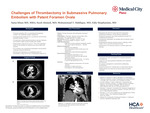
BACKGROUND/ INTRODUCTION: Submassive, or intermediate-risk, pulmonary embolism (PE) is defined by preserved systemic blood pressure with evidence of right ventricular (RV) strain. The presence of a patent foramen ovale (PFO) in this setting significantly increases the risk of hypoxemia, paradoxical embolization, and procedural complications during catheter-based interventions. Mechanical thrombectomy has become an important treatment option for selected patients with intermediate- to high-risk PE; however, experience in patients with concomitant large PFOs remains limited.
CASE PRESENTATION: A 78-year-old woman presented with acute dyspnea, hypoxemia, and chest pain and was found to have a saddle PE with severe RV dilation and biomarker elevation. She was transferred for mechanical thrombectomy but the initial procedure was aborted after repeated guidewire passage through a large PFO into the left atrium, preventing safe access to the pulmonary arteries. In the intensive care unit, half-dose systemic thrombolysis was administered without clinical or radiographic improvement. Due to persistent hypoxemia and severe RV dysfunction, a multidisciplinary discussion involving vascular surgery, cardiology, cardiac surgery, and critical care resulted in a planned repeat thrombectomy with cardiac surgery on standby. During the second attempt, RV access was achieved, and extensive thrombus was removed from both pulmonary arteries using a mechanical thrombectomy system. RV pressures improved significantly following thrombectomy. A temporary IVC filter was placed to mitigate the risk of paradoxical embolization. The patient rapidly improved after intervention, was weaned off oxygen within 24 hours, and demonstrated progressive recovery of RV function. Follow-up echocardiography showed resolution of right-to-left shunting across the PFO. She was discharged to acute rehabilitation on oral anticoagulation.
DISCUSSION: This case highlights the unique challenges of managing submassive PE in the presence of a large PFO, including catheter malposition due to elevated RV pressures and increased risk of systemic embolization. It demonstrates that repeat mechanical thrombectomy may be safe and effective following an aborted initial attempt when performed with multidisciplinary planning and surgical backup. Recognition of intracardiac shunts and their hemodynamic implications is critical when planning interventional PE therapies.
TEACHING / LEARNING POINTS:
- Submassive PE with concomitant PFO is a high-risk combination that increases the likelihood of hypoxemia, stroke, and hemodynamic compromise.
- Large PFOs with markedly elevated RV pressures can redirect guidewires into the left atrium during thrombectomy attempts, preventing access to the pulmonary arteries.
- Mechanical thrombectomy may still be feasible after an aborted initial attempt, particularly after hemodynamic optimization or procedural modification.
- Multidisciplinary coordination among vascular surgery, cardiology, cardiac surgery, and critical care teams is essential in complex PE cases.
- Reduction of RV pressures after successful thrombectomy can decrease or eliminate right-to-left shunting across a PFO.
Original Publisher
HCA Healthcare Graduate Medical Education
Recommended Citation
Khan, Sana; Ahmed, Syed; Siddique, Muhammad T.; and Stephanian, Edic, "Challenges of Thrombectomy in Submassive Pulmonary Embolism with Patent Foramen Ovale" (2026). North Texas GME Research Forum 2026. 33.
https://scholarlycommons.hcahealthcare.com/northtexas2026/33
Included in
Cardiovascular Diseases Commons, Congenital, Hereditary, and Neonatal Diseases and Abnormalities Commons, Respiratory Tract Diseases Commons